

We Finally Captured an Atom — Here’s What That Means for Science
For centuries, atoms have been the invisible foundation of everything around us — from the air we breathe to the stars in the sky. We've known they exist through theory, experimentation, and indirect observations. But what if we could actually see one? That once-unimaginable milestone has now become reality.
Welcome to one of the most awe-inspiring breakthroughs in science: the first real photograph of a single atom.
How Do You “Photograph” an Atom?
Atoms are extremely small — about 0.1 nanometers wide, far below what the human eye or even a regular microscope can detect. So how did scientists do it?
The answer lies in high-precision imaging technologies, like:
Scanning Tunneling Microscopy (STM)- Developed in the 1980s, STM uses a needle-like probe that hovers just above a surface at the atomic level. When a voltage is applied, electrons “tunnel” between the atom and the probe, allowing scientists to measure current and map atomic positions with incredible accuracy.
Instead of light, STM images atoms using electron behavior — essentially “feeling” the atom with sub-nanometer precision. The result is a topographic map that visually reveals the shape and arrangement of atoms on surfaces.
The Photograph That Shocked the World
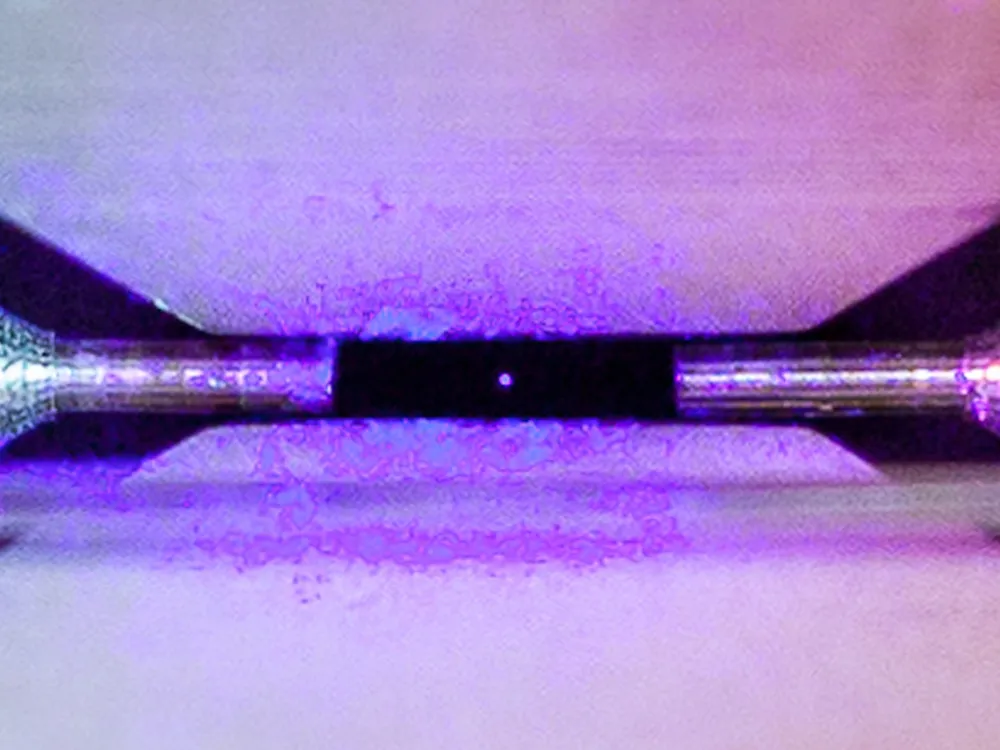
One of the most famous moments came in 2018, when physicist David Nadlinger from the University of Oxford captured an image of a single strontium atom suspended in mid-air using ion trapping.
The atom was held in place between two metal electrodes using electromagnetic fields.
A laser was shone onto the atom, and it absorbed and re-emitted the light.
With a long-exposure camera shot, the tiny dot of glowing light was captured — the first time a single atom was visibly photographed by a conventional camera.
It looked like a glowing speck between two needles — and it was all real.
Why This Is So Important
- Being able to observe atoms directly has huge implications for science and technology. Here’s why:
- Better Understanding of Matter
- We can now visualize atoms in real-time, not just guess their positions through indirect means. This strengthens our ability to understand and manipulate materials at the atomic level.
- Quantum Research
- Atoms behave differently under quantum laws. Observing them closely helps researchers study quantum states, superposition, and entanglement — vital for quantum computing..
- Nanotechnology and Engineering
- Engineers can use atomic imaging to build custom structures one atom at a time, enabling futuristic developments like atomic memory and molecular machines.
But Is It Really a Photo?
Not in the way we photograph people or landscapes. When you “see” an atom, you're actually seeing either:
Laser light scattered off a suspended atom (as in Nadlinger’s photo), or
A rendered map of electron densities based on atomic measurements (in STM images).
So while it’s not like clicking a snapshot on your phone, it is a direct visual capture — and in scientific terms, that’s still revolutionary.
A New Way of Seeing Reality
For most of human history, atoms were just an idea — a concept to explain the unseeable. Now, with cutting-edge imaging tools, we’re witnessing the real building blocks of existence with our own eyes.
It’s a stunning reminder that no matter how much we think we know, there’s always more hiding in the smallest corners of the universe — waiting to be seen.