

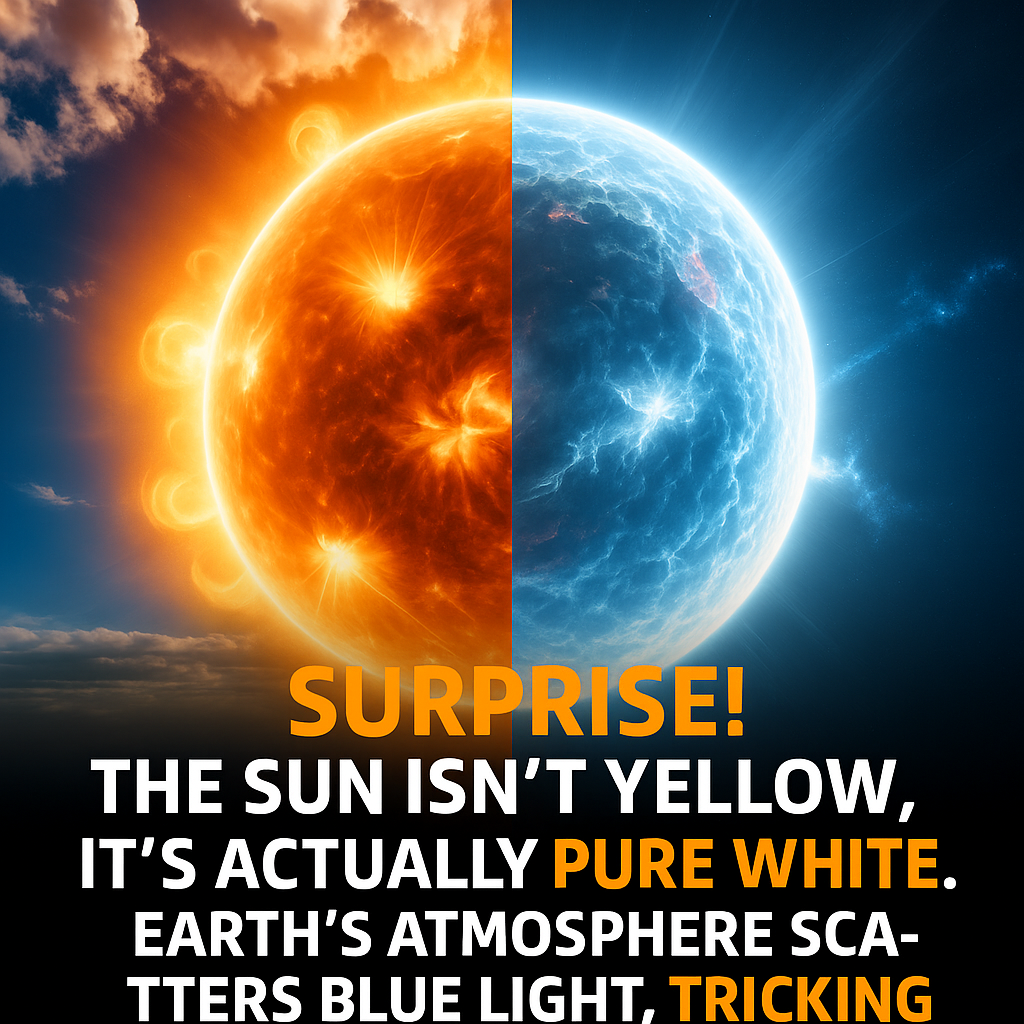
The Sun Isn’t Yellow — It Just Looks That Way from Earth
Here’s Why the Brightest Thing in the Sky Is Actually White
Most people grow up thinking the Sun is yellow — it’s drawn that way in children’s books, emojis, weather apps, and even science diagrams. But in reality?
The Sun is not yellow. It’s actually pure white.
Sounds surprising, right? But it’s true — and it all has to do with how light and our atmosphere work together.
Let me explain.
Why the Sun Looks Yellow from Earth
When we look up at the Sun during the day, we’re not just seeing it directly — we’re seeing it through Earth’s atmosphere.
Sunlight is made up of many colors — violet, blue, green, yellow, orange, red — all combined. Together, they make white light.
But when sunlight enters our atmosphere, something happens.
The shorter wavelengths of light — like blue and violet — get scattered in all directions by molecules and particles in the air. This is called Rayleigh scattering (the same reason the sky looks blue).
As a result, the light that continues straight to our eyes from the Sun has less blue and violet left, and more yellow, orange, and red.
That’s why the Sun appears yellowish or orange when we see it from Earth.
But in Space, Without an Atmosphere…
Now imagine you're in space — no air, no scattering.
If you looked at the Sun from a spacecraft or the International Space Station (with protective gear, of course), you wouldn’t see yellow at all.
You’d see a bright white sphere — the Sun’s true color.
Because in space, all of the Sun’s colors reach your eyes at once — none are filtered out. And when all colors of light mix together, the result is white light.
A Simple Way to Understand It:
Think of the Sun like a white LED light. It gives off every color at once — red, green, blue, and everything in between.
Now think of Earth’s atmosphere like a tinted window. When the light passes through it, some colors get blocked or scattered — and what we see is just what’s left.
That leftover light looks yellowish to us — but it doesn’t mean the light itself is yellow.
That’s Also Why Sunsets Look Red and Orange
At sunrise and sunset, the Sun’s light travels through even more atmosphere — the longest path it can take.
This scatters the blue and green light even more, leaving behind mostly red and orange wavelengths.
That’s why the Sun can look fiery red or deep orange during those times — it’s not changing color, we’re just seeing it through more of the atmosphere.
Scientific Confirmation
Scientists classify the Sun as a G-type main-sequence star — sometimes called a "yellow dwarf."
But that label is more about temperature and classification than actual color.
The Sun’s temperature (~5,778 Kelvin) means it emits a balanced spectrum of light — which appears white to the human eye when unfiltered.
Even astronauts confirm:
“The Sun in space looks pure white — blindingly bright, but not yellow.”
Final Takeaway
| What We Think | What’s True |
|---|---|
| The Sun is yellow | The Sun is white — it only looks yellow because of Earth's atmosphere |
So next time you look up at that golden glow in the sky, just remember:
The Sun isn’t yellow.
It’s your atmosphere that’s playing tricks on your eyes.