
The Organism That Defies Biology: Sukunaarchaeum mirabile and the Blurred Line Between Life and Virus
The Organism That Defies Biology: Sukunaarchaeum mirabile and the Blurred Line Between Life and Virus
In the vast, mysterious depths of the ocean, scientists have just stumbled upon something that’s causing ripples far beyond marine biology. Sukunaarchaeum mirabile, a microscopic organism discovered among marine plankton, has emerged as one of the most unusual lifeforms ever identified. It’s not quite a virus. It’s not fully a living cell either. And that’s exactly what makes it so groundbreaking.
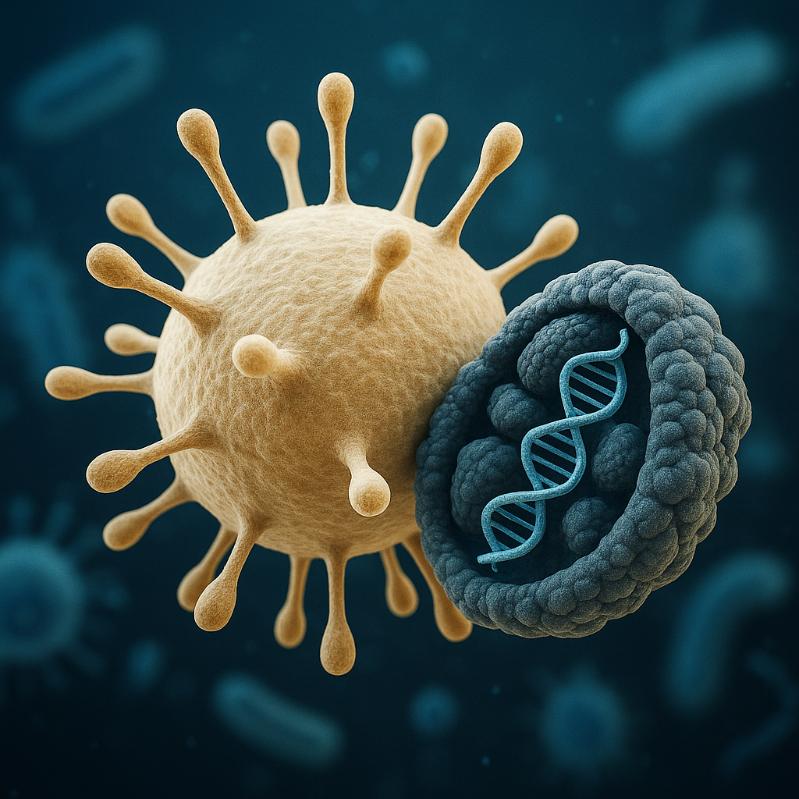
This tiny entity, with a name as curious as its behavior, has a genome measuring only 238,000 base pairs—less than half the size of any known archaeal genome. And yet, within that miniature genetic structure lies something astonishing: Sukunaarchaeum mirabile can build its own ribosomes and synthesize RNA. These are fundamental features of cellular life. Viruses, for instance, cannot do this. They hijack the machinery of other cells. But this organism seems to operate in an eerie middle ground.
That middle ground is what’s got the scientific community so fascinated—and confused.
Like a virus, S. mirabile is dependent on a host for survival. It lacks most of the typical metabolic pathways needed to function independently. But unlike a virus, it doesn’t entirely give up its autonomy. It retains just enough cellular function to perform critical life processes on its own. Think of it as a minimalist lifeform, existing on the edge of biology.
This discovery came from genomic analysis of marine plankton samples, where researchers detected something they initially couldn’t classify. What they found was an organism that defies our current binary definition of life: not dead, not quite alive in the usual sense, and certainly not following any established playbook of how organisms are supposed to behave.
The implications? Massive.
Some researchers believe that S. mirabile could represent a missing evolutionary link between the earliest forms of cellular life and viruses. It hints at a past where life wasn’t so clearly divided into neat categories. In fact, it may reveal that the earliest life on Earth existed on a continuum—gradually evolving complexity, instead of leaping from virus-like particles to full-fledged cells.
Even more intriguing is what this means for astrobiology and the search for life beyond Earth. If something this strange exists here, in Earth’s oceans, what kinds of weird, hybrid lifeforms could be hiding in the subsurface oceans of Europa or Enceladus? The discovery of Sukunaarchaeum mirabile adds fuel to the idea that life might be far more diverse—and more alien—than we’ve dared to imagine.
So while it may be just a speck floating in the sea, this strange little organism is casting a big shadow over what we thought we knew. It’s a reminder that life, in all its forms, is far more mysterious, messy, and miraculous than we give it credit for. And sometimes, redefining life itself starts not in a grand laboratory, but in a single droplet of seawater.