

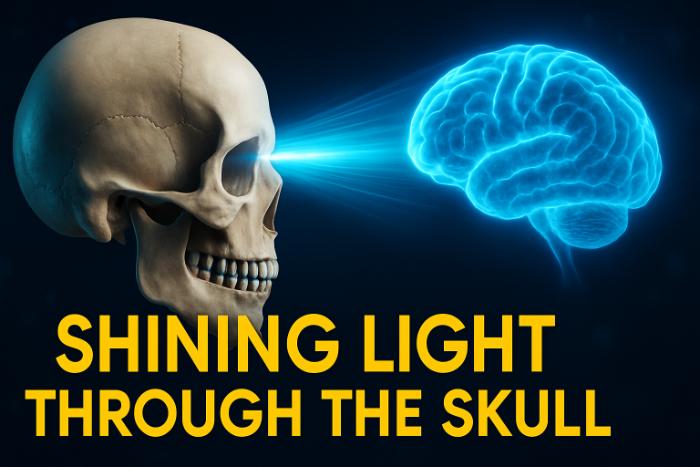
Shining Light Through the Skull
Shining Light Through the Skull
For decades, scientists have been trying to find new ways to look deep inside the human brain without using huge machines or cutting into the body. Now, something that seemed impossible has actually happened. Researchers at the University of Glasgow have successfully passed light straight through a human skull, from one side to the other, using a method called functional near-infrared spectroscopy — or fNIRS.
In their study, they worked with eight participants. Out of those, one showed a clear result: light managed to travel across the skull. That might sound small, but it’s a huge step. Normally, our skull and brain tissue scatter and absorb most of the light, making it nearly impossible to get a clear reading. But in this case, it worked. Not by blasting the skull with stronger lasers, but by carefully increasing the power within safe medical limits, and most importantly, by improving the way the light was collected on the other side.
The team noticed that the light didn’t just pass through randomly. It followed preferred routes — like natural tunnels inside the head, such as cerebrospinal fluid channels — guiding the photons across. That alone is a major discovery. It means there are natural paths in the brain that can help us scan it more effectively, without needing big MRI machines or invasive tools.
The process is still slow, and it didn’t work on every person. But this one success shows that we’re on the edge of something big. For patients with brain injuries, strokes, or neurological conditions, this could eventually allow doctors to monitor their brains in real-time, right at the bedside, with just a compact, non-invasive light device. No more being pushed into giant scanners or waiting hours for imaging results.
It’s early, and it’s not perfect yet — but science just proved that it’s possible. And with each small step, we’re moving toward a future where even the deepest parts of the mind can be seen clearly… all through a quiet, carefully focused beam of light.