

Humans on Mars: NASA’s Most Ambitious Journey Yet Could Begin by 2035
NASA is aiming for one of the most ambitious goals in space history — sending humans to Mars by 2035. After decades of robotic missions, this would be the first time humans leave Earth’s neighborhood and travel to another planet. The mission won’t just be for show — astronauts will explore Mars’ surface, search for signs of past life, and study the planet’s climate and geology to learn how it became dry, cold, and airless.
The journey itself will be no small task. A round trip could take over a year, with astronauts spending up to 500 days on Mars. To prepare for this, NASA is using its Artemis program, which plans to return humans to the Moon first. By 2026, Artemis III is set to land astronauts at the Moon’s south pole, where they’ll test life-support systems, extract water from ice, and practice deep-space survival — all essential skills before attempting Mars.
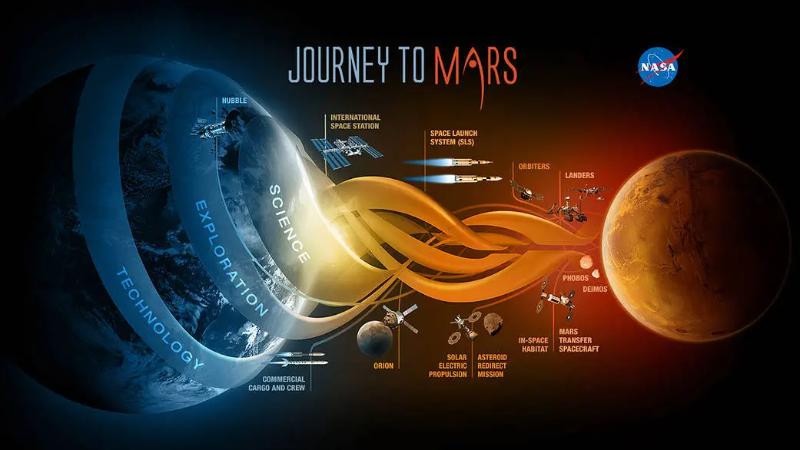
NASA is also developing powerful technologies to make the Mars mission possible. The Space Launch System (SLS) will be the rocket that carries the crew beyond Earth. The Orion spacecraft will serve as their vehicle in deep space. Once on Mars, astronauts will rely on advanced spacesuits, habitats, and tools like MOXIE, which can produce oxygen from the Martian atmosphere. There are also plans for laser-based communication and systems that recycle air, water, and food — since resupply missions from Earth won’t be easy.
The goal isn’t just to visit Mars — it’s to lay the foundation for long-term human presence on another planet. If successful, this mission could open the door to future exploration, human settlements, and even help scientists understand more about Earth by studying its closest planetary cousin. While there are still major challenges ahead, the countdown to Mars has already begun — and it might happen sooner than most people think.