
How One Solar Event Could Wipe $2 Trillion from the World’s Economy
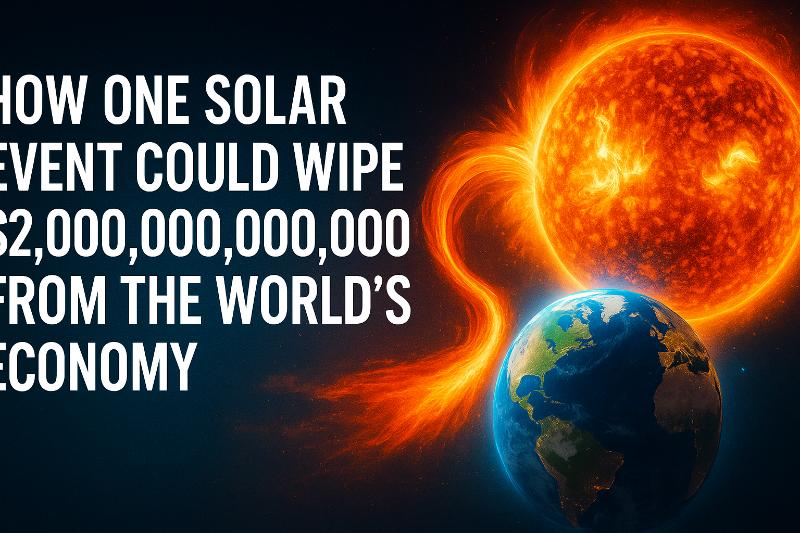
How One Solar Event Could Wipe $2 Trillion from the World’s Economy
It sounds like science fiction: a burst of energy from the sun so powerful that it could cripple global infrastructure. But this isn’t a movie plot — it’s a real possibility.
Scientists have long warned about solar storms — massive eruptions from the sun’s surface that send charged particles hurtling toward Earth. While most solar activity is harmless, a major solar storm — known as a "Carrington Event" — could have catastrophic effects on modern technology.
In 1859, the strongest solar storm ever recorded — the original Carrington Event — caused telegraph systems to spark and fail. If something like that happened today, the damage would be far worse. We now rely on satellites, GPS, power grids, internet cables, and digital banking systems — all of which could be knocked out in a matter of minutes.
What Happens During a Major Solar Storm?
A huge solar flare or coronal mass ejection (CME) sends billions of tons of plasma toward Earth. If it strikes our planet’s magnetic field directly, it can cause:
- Global GPS disruption
- Massive blackouts in major cities
- Communication failure (cell towers, internet, aircraft nav)
- Satellite damage (potentially destroying billion-dollar assets)
- Banking and financial delays due to knocked-out servers
- Damage to power grid transformers, requiring months to repair
According to a Lloyd’s of London and Atmospheric and Environmental Research study, a severe storm could cause an estimated $2 trillion in economic losses — in just the first year. Recovery could take up to a decade in some areas.
Countries at higher latitudes — like the U.S., Canada, parts of Europe, and northern Asia — are most vulnerable. These regions are more exposed to geomagnetic effects. But in our globalized world, even countries in safer zones would feel the impact through economic chain reactions.
NASA and space agencies now monitor solar activity constantly. Satellites like the Solar and Heliospheric Observatory (SOHO) give Earth advanced warning — sometimes just 12 to 48 hours before impact.
Some governments and companies are starting to harden power grids and satellites, building surge protection into critical infrastructure. But most systems remain vulnerable, especially in developing nations.